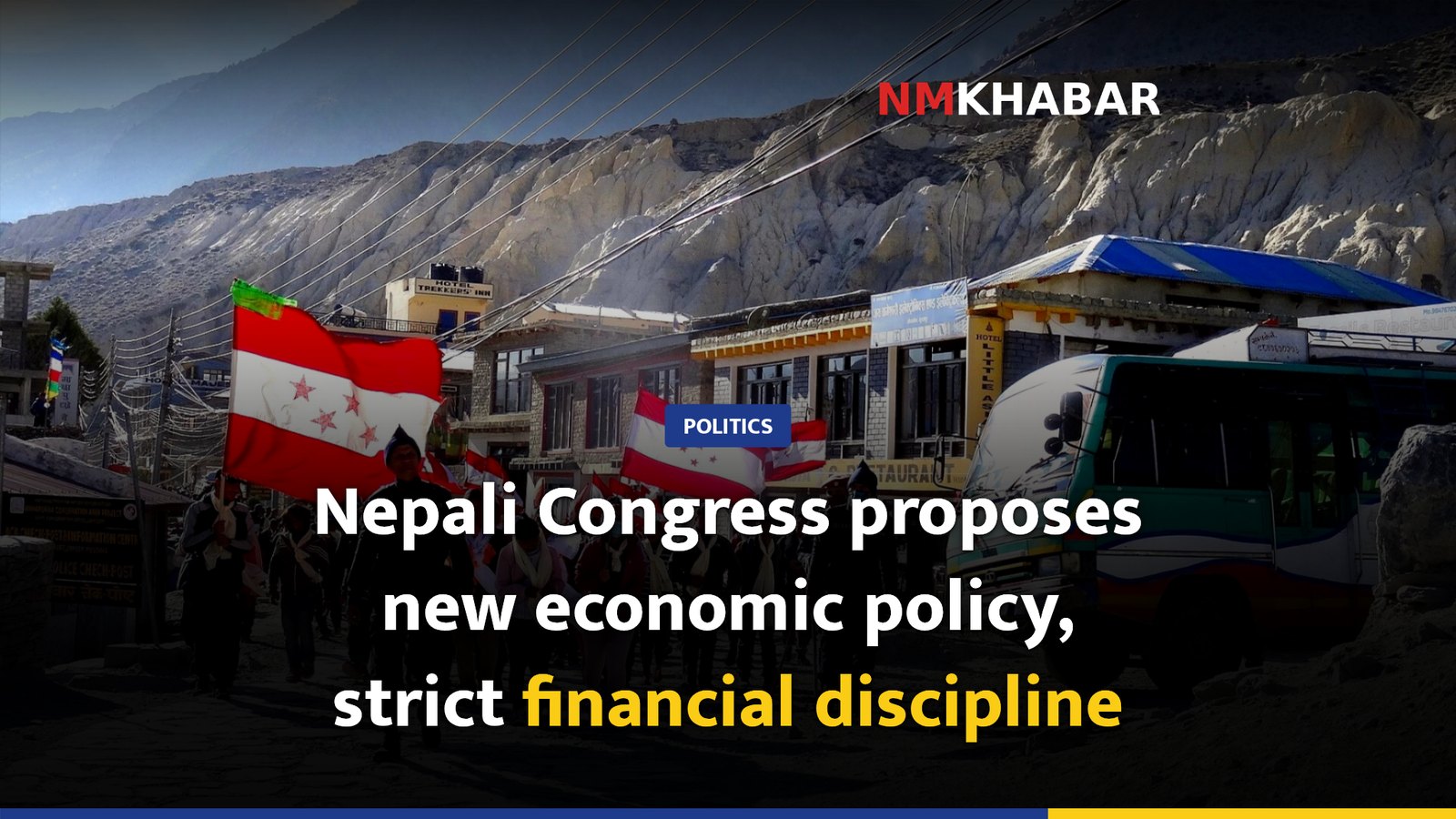
KATHMANDU – The Nepali Congress, a social-democratic political party in Nepal, has proposed a new three-pillar economic policy and strict financial discipline within the party at its 15th General Convention, which began on Sunday, October 4, 2026, in Kathmandu.
Nepali Congress President Gagan Kumar Thapa presented these policy foundations in his political report to the convention. The new economic policy is built on three pillars: ‘pro-private’, ‘pro-growth’, and ‘pro-social justice’.
New Economic Policy Pillars
The ‘pro-private’ policy aims to establish the private sector as the primary driver of prosperity, ensuring policy stability, healthy competition, and an investment-friendly environment. The government’s role will be limited to an efficient and transparent regulator.
The ‘pro-growth’ pillar emphasizes achieving high, sustainable, inclusive, and domestic production-based economic growth, prioritizing youth as genuine partners in innovation, entrepreneurship, and wealth creation.
The ‘pro-social justice’ pillar advocates for a framework that protects vulnerable and marginalized communities, enhances their capabilities, and ensures employment. This includes social security measures such as old-age allowances after 65 years, treatment allowances for patients with complex diseases, and guaranteed employment for 120 days a year.
Strict Financial Discipline for the Party
The Nepali Congress has proposed new arrangements to ensure financial transparency and discipline within the party. All party levels will operate based on approved annual and programmatic budgets, bringing financial scrutiny to fund mobilization and election expenses.
The party will scrutinize the sources of financial assistance, associated conditions, and potential conflicts of interest to prevent external influence on decision-making. Furthermore, the Nepali Congress will advocate for state funding for political parties, based on votes received, linked to strict financial discipline and public auditing.
Proposals also include maintaining certified records of party assets, implementing a uniform accounting policy, and operating economically. The party committed to regular public auditing for its financial transactions, enhancing accountability.
Addressing Past Weaknesses and Future Steps
The Nepali Congress acknowledged that over the past two decades, it prioritized positions and power over its core objectives. Self-assessment revealed that coalition management, power-sharing, factionalism, and transactional politics weakened its moral foundation. It also admitted that protecting members involved in corruption undermined public institutions and that the party had grown distant from the youth.
The 15th General Convention, attended by approximately 7,700 representatives, continues until October 8, 2026. The closed session began today, Monday, October 5, 2026, with the presentation of President Gagan Kumar Thapa’s political report, along with other key reports. Group discussions will follow.
Candidate nominations for the new Central Working Committee will be registered on Tuesday, October 6, 2026, in Kathmandu, with elections scheduled for October 7 and 8, 2026. The party plans to publish a ‘Prosperity Policy Paper’ within the first 100 days and form provincial task forces for key development areas.
The proposed economic policy aims to create domestic employment by prioritizing agricultural modernization, industrial expansion, and investment in various sectors, thereby reducing the need for foreign employment. This could particularly benefit Madhesh Province. The policy also emphasizes addressing farmers’ issues, ensuring timely fertilizer supply and fair prices, and concrete initiatives for agricultural modernization.