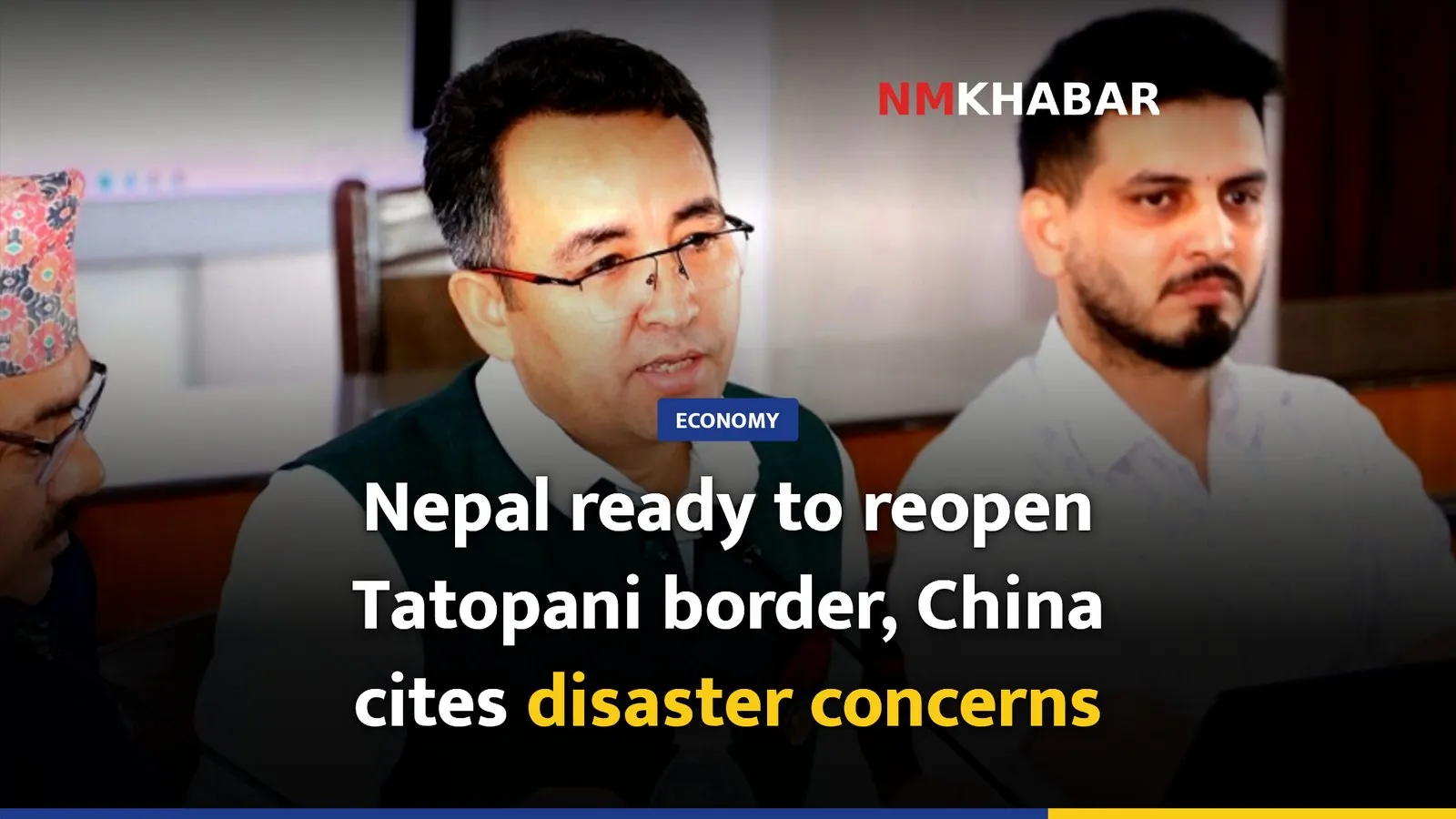
Infrastructure Development Minister Sunil Lamsal said on Tuesday that Nepal has completed all necessary work to reopen the Tatopani border crossing with China and is ready to operate it, but Beijing has not yet given the green light, citing disaster concerns. Lamsal added that discussions are taking place almost daily.
Nepal ready, China reluctant
Speaking at a meeting of the Parliamentary Special Committee on the Impact of Climate Change in the Himalayas, Climate Justice and the Bhotekoshi-Trishuli Disaster, a 15-member special committee formed by the House of Representatives and chaired by Ganesh Parajuli, Lamsal affirmed that Nepal faces no problems on its side at Tatopani, having already restored the road. However, he noted China’s reluctance to open border crossings during periods of floods and other disasters. “They are not ready yet. Our dialogue is continuing. They have not given the green signal to operate the crossing during the disaster situation,” Lamsal said, expressing confidence that it would reopen soon.
The government is also working on a plan to restore the Rasuwagadhi border crossing, another major trade route between Nepal and China. This crossing was severely damaged when a massive flood in the Tibet region swept away the Miteri Bridge on August 25, 2025. As of October 1, 2026, all three major border crossings with China—Tatopani, Rasuwagadhi, and Korala—remained closed, significantly impacting import and export activities. China has indicated its positive stance on cooperating for the reconstruction and operation of all three crossings.
Call for disaster-resilient infrastructure
During the same parliamentary committee meeting, Minister Lamsal stressed the need for a “paradigm shift” in policies related to infrastructure construction and urban development, considering the increasing risks posed by climate change. He emphasized building disaster-resilient and sustainable infrastructure, particularly in light of recent floods and landslides. Lamsal highlighted “water management” as a primary challenge, urging special importance to high flood levels and underground water levels in infrastructure development. He also pointed out that the accumulation of debris in rivers, about 5 to 10 centimeters annually in hilly areas and up to 20 centimeters in the Tarai region, has rendered existing infrastructure irrelevant due to improper management.
New designs for Bhotekoshi-Trishuli area
Lamsal announced that damaged roads and bridges in the Bhotekoshi-Trishuli area would not be rebuilt using old designs. Instead, new, safer road alignments and revised bridge designs, including long-span bridges without central pillars, are being developed in collaboration with domestic and foreign technical experts. He said reconstruction would be fast-tracked, with some tenders expected before Dashain and detailed project reports for others to follow after Dashain-Tihar. Preparations are also underway to initiate the purchasing process for damaged drinking water projects even before Dashain.
Resettlement and disaster management reforms
The minister also outlined the government’s goal to relocate disaster-affected families to safe places, working with local authorities to identify land and build houses while preserving the communities’ original identities. He said special arrangements would be made for the elderly and children, including ensuring education and employment. Furthermore, Lamsal informed that the structure and legal framework of the National Disaster Risk Reduction and Management Authority (NDRRMA) would be revised to enable federal, provincial, and local levels to operate in parallel during disaster management. Lamsal added that the government plans to make all three levels of government resource-rich and move forward in a coordinated way.
Economic impact and future uncertainties
The prolonged closure of the Tatopani, Rasuwagadhi, and Korala crossings has caused problems for businesses, especially with major festivals like Dashain, Tihar, and Chhath approaching, affecting the import of clothing, footwear, electronics, and decorative items. The closure of Rasuwagadhi forces Nepal to use India’s Kolkata route as an alternative, significantly increasing transportation time and costs for Chinese goods. While Minister Lamsal expressed confidence in reopening Tatopani soon and China has shown a positive attitude towards cooperation on all three crossings, the exact date for Tatopani’s reopening remains uncertain. It is also unclear if China has specific conditions beyond disaster concerns for resuming operations or the detailed timeline for the reconstruction and full operation of Rasuwagadhi and Korala.