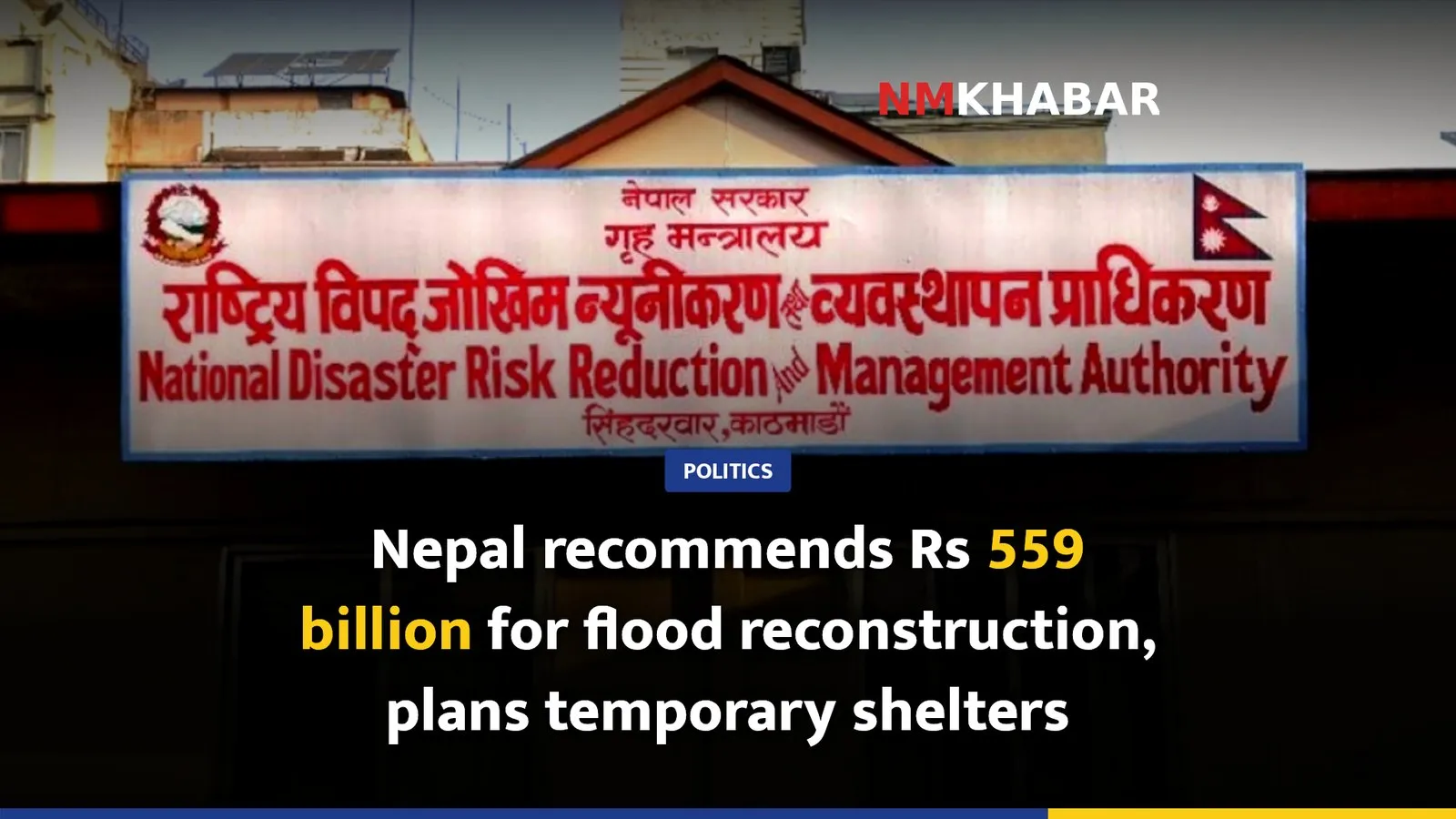
Nepal’s government has decided to construct transitional shelters for families affected by the devastating Bhote Koshi flood and recommended a substantial budget of Rs 559 billion for reconstruction and rehabilitation efforts. The decision was made at a meeting of the National Council for Disaster Risk Reduction and Management, Nepal’s apex body for disaster management, on Tuesday, October 6, 2026.
The meeting, chaired by Prime Minister Balen Shah, called on development partner organizations willing to assist in reconstruction to inform the National Disaster Risk Reduction and Management Authority (NDRRMA) about the number of homes they plan to build and in which local municipalities. According to the Office of the Prime Minister and Council of Ministers, partner organizations must construct homes on government-provided land, adhering to specified standards. Local levels have also been instructed to collect detailed information on actual beneficiary families in affected areas to determine the exact number of shelters required.
The 21st meeting of the National Council for Disaster Risk Reduction and Management, also chaired by Prime Minister Shah, approved a recommendation to the Ministry of Finance for a budget of Rs 559 billion for 504 plans and programs aimed at reconstruction and rehabilitation in the Bhote Koshi-Trishuli flood-affected areas.
Background to the Flood and Displacement
The devastating Bhote Koshi flood, which occurred on August 26, 2026, in Rasuwa district, caused significant human and material losses. According to the Bagmati Province Police Office, 22 people died across Rasuwa, Nuwakot, Dhading, and Chitwan districts. A month after the flood, 45 students from three government and one private school in Rasuwa remain missing.
Thousands were displaced after their homes, farmlands, and livelihoods were swept away. Initially, over 1,000 people in Rasuwa and approximately 2,500 in Nuwakot were provided temporary shelter. As of October 1, 2026, only 389 individuals were residing in holding centers in Nuwakot and Rasuwa. The government previously provided a total grant of Rs 50,000 in two installments for temporary housing to affected households. Our earlier report detailed the initial casualties and changes in the temporary housing plan.
Economic Impact and Climate Justice Call
The flood also led to the closure of the Rasuwa border point, impacting Nepal-China trade. Dr. Dharmaraj Upadhyaya, Executive Chief of the NDRRMA, described the Bhote Koshi-Trishuli corridor flood as a ‘Himalayan Tsunami.’ The World Bank projected that disruptions to industry and services caused by the Rasuwa flood would limit Nepal’s economic growth to 3.7 percent in the fiscal year 2083/84. Previously, Padmakumar Mainali, Secretary at the Ministry of Physical Infrastructure Development, stated that recent disasters caused Rs 227 billion in infrastructure damage, with an immediate need of Rs 63 billion for reconstruction. More details on infrastructure damage were published earlier.
Amidst these challenges, Speaker Dolprasad (DP) Aryal addressed the 153rd Assembly of the Inter-Parliamentary Union (IPU), emphasizing the need for global parliaments to unite for climate justice. He highlighted Nepal’s disproportionate suffering from climate change impacts despite its negligible contribution to global greenhouse gas emissions, advocating for increased access to climate finance for Nepal. Speaker Aryal proposed strengthening parliamentary networks among climate-vulnerable nations to enhance disaster risk reduction, Himalayan resilience, and climate finance. He also showcased Nepal’s parliamentary inclusivity, with significant representation of women, various inclusive groups, persons with disabilities, and youth in the House of Representatives, the lower house of the federal parliament. Efforts are underway to transform Nepal’s parliament into a digital, paperless, and transparent system, including live broadcasts and sign language interpretation of parliamentary sessions.
Uncertainties and Next Steps
Despite the decision to build temporary shelters, the exact number of actual beneficiary families and the total number of shelters required remain undetermined. No specific deadline has been set for partner organizations to inform the NDRRMA or for local levels to collect beneficiary data. Furthermore, detailed information regarding the government-provided land and the specified construction standards for temporary housing is not yet available.
The Ministry of Law is in continuous discussions with the NDRRMA regarding legal procedures for declaring and registering the deaths of individuals missing after the Bhote Koshi disaster. The NDRRMA has also been instructed to recommend necessary budget arrangements to the Ministry of Finance once details of uncosted and unprioritized projects are received. Official and final figures for the death toll from the Bhote Koshi flood remain unclear due to differing statistics from various sources.