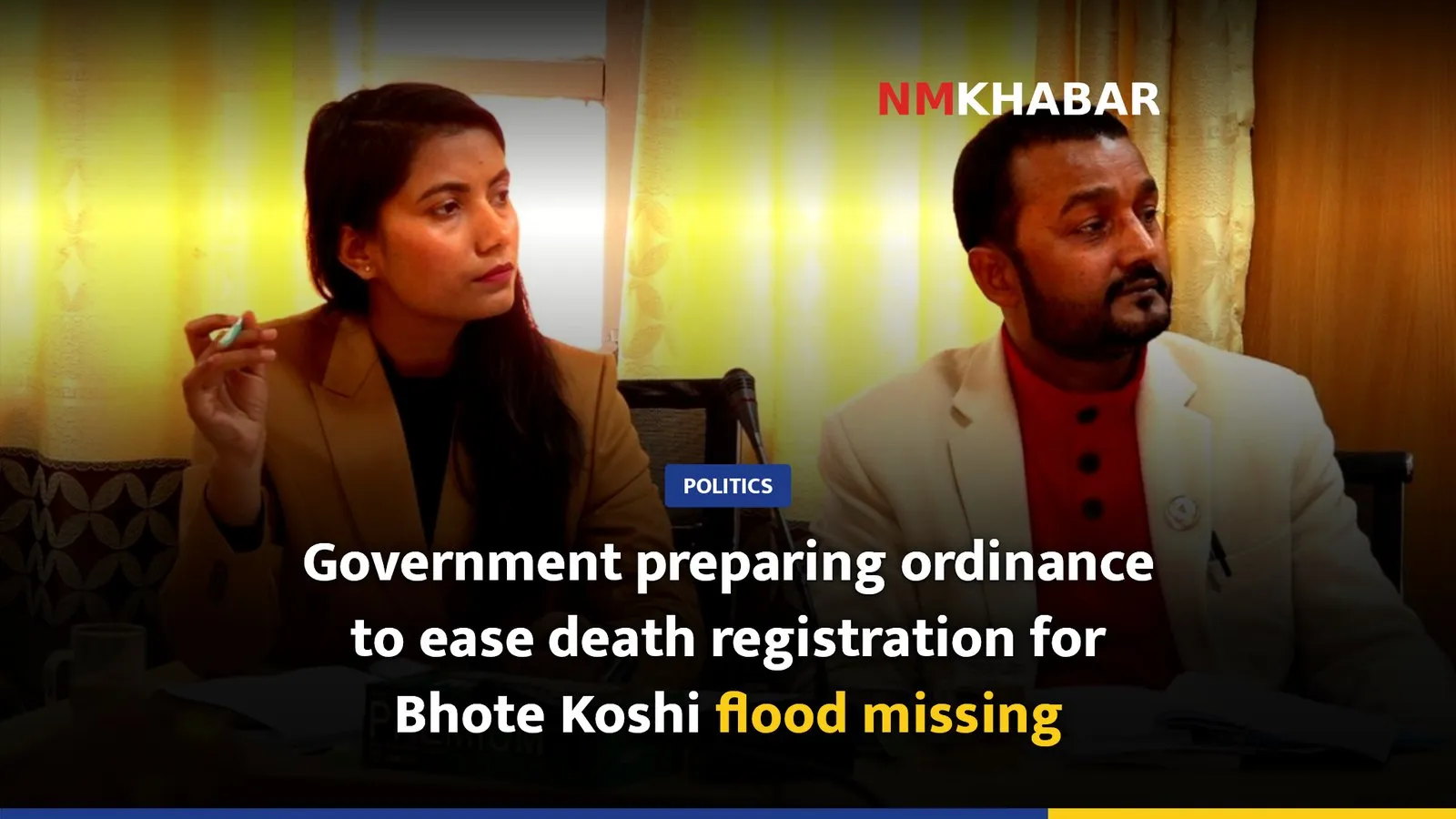
Law Minister Sobita Gautam informed a parliamentary special committee on Tuesday that an ordinance to declare missing persons dead is in its final stages. The government is preparing this ordinance to ease the process for families of those missing after the devastating Bhote Koshi flood to register deaths and claim benefits.
The move comes in response to significant legal hurdles faced by families seeking to process insurance claims, property transfers, and pension benefits for relatives who disappeared in the disaster. The existing Muluki Civil Code, 2074 (BS), Nepal’s civil code, stipulates that a person can only be presumed dead after 12 consecutive years without any information.
Legal Hurdles for Families
Under Section 40 of the Muluki Civil Code, 2074 (BS), a person is legally presumed dead only after 12 years of continuous disappearance without any information in normal circumstances. While the code provides for exceptions in special cases—such as five years for individuals aged 80 or above, four years after the end of a war for soldiers deployed in war zones, and three years after an air, sea, or vehicle accident—these require a judicial declaration of death from a court.
Even with a judicial declaration, the provision allows for its annulment if the person returns alive. Furthermore, the National Identity Card and Registration Regulation, 2077 (BS), which governs identity cards and civil registration, mandates in Rule 17 that local registrars cannot record such events without official verification from a competent authority. This complex legal framework has left families unable to access crucial financial and social support.
The Disaster Risk Reduction and Management Act, 2074 (BS) and its Regulations, 2076 (BS) include provisions for minimum relief to families of deceased persons. However, they lack clear mechanisms to immediately treat missing persons as deceased for relief purposes, exacerbating the challenges faced by affected families.
Scale of the Bhote Koshi Disaster
The urgency for this ordinance stems from the catastrophic Bhote Koshi flood that occurred on Bhadra 10, 2083 (September 10, 2026). According to Nepal Police data from Ashoj 15, 2083 (BS), 4,720 individuals remain missing, while 1,457 bodies have been recovered. Shanti Mahat, spokesperson for the National Disaster Risk Reduction and Management Authority (NDRRMA), stated on Ashoj 16, 2083 (BS) that approximately 5,000 people are still missing, with residents from 74 to 75 districts affected by the disaster in Rasuwa.
The flood also impacted foreign nationals, with approximately 590 citizens from 38 countries still missing as of Bhadra 15, 2083 (BS). Among them, 54 Malaysian citizens were reported missing. In Madhesh Province, 30 individuals who went missing in the Bhote Koshi flood have since been contacted, but 162 others from the province remain unaccounted for.
Currently, the disaster relief procedure provides Rs 200,000 in relief to the families of those who died in a disaster. However, for missing persons, their disappearance must first be confirmed, adding to the bureaucratic burden. In a related effort, the Nuwakot Civil Servants Society provided Rs 25,000 each in cash relief to the families of 20 civil servants from Nuwakot who were killed or went missing in the Bhote Koshi flood on Ashoj 17, 2083 (BS).
Government’s Legislative Push
The Ministry of Home Affairs had previously prepared a draft of the “Bill to Amend Some Nepal Acts Related to Disaster” and sought public feedback until Ashoj 7, 2083 (BS). Law Minister Gautam affirmed on Ashoj 16, 2083 (BS) that the law would apply equally to both Nepali and foreign nationals affected by the disaster, and that work is underway to simplify the process for declaring missing persons dead and issuing death certificates.
Minister Gautam also announced on Ashoj 18, 2083 (BS) that the Ministry of Law is observing the current fiscal year as the ‘Law Reform and Construction Year,’ with plans to identify and amend necessary laws. This legislative initiative aims to address the practical difficulties faced by families, who, despite performing final rites, are legally bound to list their relatives as missing in government records.
Next Steps and Unanswered Questions
Constitutionally, an ordinance must be presented in the first session of parliament after its promulgation. It automatically becomes inactive if rejected by both houses or revoked by the President within 60 days. Speaker Dol Prasad Aryal stated on Ashoj 16, 2083 (BS) that Prime Minister Balen Shah’s scheduled response to parliamentary questions on Bhadra 10 (BS) was postponed due to the Bhote Koshi flood, and the government would address citizens’ questions through parliament in the future. Speaker Aryal also announced plans to raise Nepal’s disaster and climate change issues at the 153rd General Assembly of the Inter-Parliamentary Union (IPU) in Tanzania.
Despite these developments, the exact date for the ordinance’s issuance remains unknown. The specific name and chairperson of the ‘parliamentary special committee’ mentioned in the source article are also unclear. Furthermore, the detailed amendments to the Muluki Civil Code, the National Identity Card and Registration Act, and the Disaster Risk Reduction and Management Act have not been fully disclosed. The scientific cause of the Bhote Koshi flood and the impact of climate change are still under study, with a government expert committee reportedly stalled on the event’s nomenclature. The full economic impact, including lost foreign exchange from electricity exports and customs revenue due to border closures, is yet to be fully assessed.
This legislative effort follows earlier government commitments to amend laws for easier death registration of those missing in the Bhote Koshi-Trishuli disaster. For more information on the government’s earlier plans, please refer to our previous report: Government to amend laws for death registration of Bhote Koshi-Trishuli disaster missing.