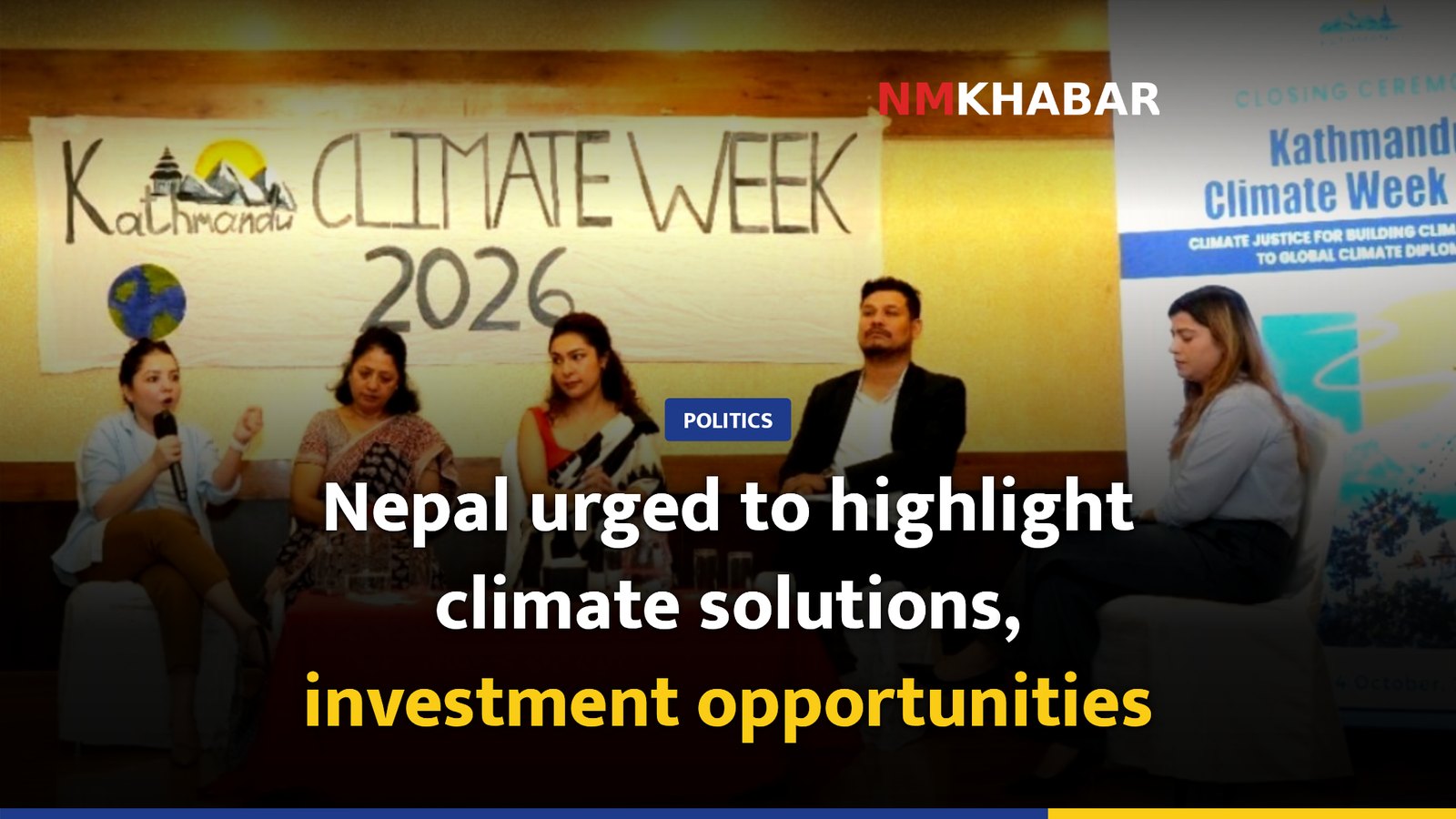
Kathmandu, October 4, 2026 – Experts, lawmakers, and entrepreneurs at the conclusion of Kathmandu Climate Week urged Nepal to present itself on international platforms not merely as a victim of climate change but as a significant contributor to global climate solutions and an attractive destination for green investment.Speaking at the ‘Nepal’s Voice for Climate Justice: Climate Action and Climate Diplomacy’ session on Sunday, the final day of the event, they emphasized that while advocating for climate justice, Nepal must also showcase its community-level initiatives and past achievements in addressing climate challenges.Former Foreign Minister Bimala Rai Paudyal stressed the importance of strong preparation, political will, a capable bureaucracy, and expert coordination for effective diplomacy. “When political will, institutional capacity, and expertise are coordinated, diplomacy works effectively,” she said, adding that dialogue, connection, and implementation with the global community are essential for a just and resilient Nepal.Anushka Shrestha, a member of the House of Representatives, the lower house of parliament, highlighted the need to include diverse voices in climate decision-making processes. She stated that the priority should be to create effective mechanisms where the voices of various communities and individuals can be easily heard, ensuring climate justice in its true sense.Samriddhi Gyawali, a media entrepreneur, climate and clean energy investor, and activist, argued against portraying Nepal solely as a country at risk. “Nepal faces climate risks, but it also has opportunities,” she said. “In international climate negotiations, Nepal must clearly articulate what it can do and how it can contribute to stopping global temperature rise.”Gyawali noted that repeatedly focusing only on risks and damages could lead the international community to perceive Nepal merely as a ‘victim.’ She asserted that Nepal has much more to offer, particularly in clean energy, where it can make a significant contribution to South Asia.Nepal’s electricity generation capacity has increased from approximately 800 megawatts a decade ago to about 3,798 megawatts today, primarily from hydropower. The country also has an estimated technical solar energy potential of 432 gigawatts, ten times its hydropower potential. Gyawali highlighted that by further expanding its clean energy production, Nepal could supply clean energy to other South Asian countries, contributing to global temperature reduction.She urged Nepal to attract impact investment rather than viewing climate finance solely as compensation or aid. “While Nepal lacks sufficient public budget for climate risk reduction and protecting disaster-affected communities, it should link investment with climate justice in international dialogues,” Gyawali suggested, calling for Nepal to invite global investors for co-investment in clean energy and other sustainable sectors. Climate activist Abhishek Shrestha echoed the need for Nepal to attract climate finance both domestically and internationally, citing insufficient budget for climate change mitigation and adaptation.Kathmandu Climate Week 2026, held from October 1-4, 2026, served as a three-day national platform bringing together policymakers, climate experts, researchers, youth leaders, civil society, businesses, investors, journalists, technologists, and local practitioners. Despite contributing less than 0.1 percent to global greenhouse gas emissions, Nepal’s population faces significant loss of life and property due to the climate crisis. Over 80 percent of its population is affected by varying impacts across its diverse regions.The recent “Himalayan tsunami” in the Bhote Koshi and Trishuli rivers, which occurred a month before September 18, 2026, highlighted the urgency of climate action, with preliminary estimates for reconstruction costs reaching up to Rs 390 billion. In response, Nepal has established an Environment Diplomacy Branch within the Ministry of Foreign Affairs and a 15-member special parliamentary committee to address climate impacts, justice, and long-term risk reduction.Nepal plans to effectively raise issues of climate-induced disasters, impacts on energy and water resources, and the need for climate finance at the 31st Conference of the Parties (COP31) to the United Nations Framework Convention on Climate Change, scheduled for November 9-20, 2026, in Turkey. The government is also preparing to introduce a new Climate Change Policy for the fiscal year 2083 BS (2026/2027 AD), with activists demanding priorities for victim justice, access to finance, and accountability.
Nepal urged to highlight climate solutions, investment opportunities
Experts and leaders at Kathmandu Climate Week urged Nepal to present itself as a contributor to global climate solutions and an attractive destination for green investment, moving beyond a narrative of vulnerability.
NM Khabar English Desk
5 October 2026, 3:05 pm
4 min read
Size:
NM Khabar English Desk
Correspondent · NM Khabar
NM Khabar staff reporter. Follow us for accurate, fact-based and fair reporting from Nepal.