Update (23:18 NST, October 2, 2026)
Nepal Police have recovered 1,455 bodies following devastating monsoon-related disasters, a significant increase from previous reports. Authorities are currently processing 3,406 DNA samples to identify victims and reunite them with families. The National Forensic Science Laboratory is analyzing samples from recovered remains and relatives of the missing, with assistance from international teams expected to expedite the matching process.
The government has shifted its focus from search and rescue to recovery and reconstruction, with an estimated Rs 723.31 billion needed for rehabilitation efforts. The floods have caused extensive damage to infrastructure, including bridges and telecommunications sites, with some areas facing up to a year for access restoration.
Separately, Nepal will launch a six-year, $50 million project funded by the Green Climate Fund, UNDP, and the government to lower the water levels of four glacial lakes, aiming to prevent future dam breaches and floods. This initiative follows a recent avalanche in Manang district that resulted in 15 deaths.
Update (21:12 NST, October 2, 2026)
Nepal Police have recovered 1,455 bodies as of Friday, October 2, 2026, due to the devastating Bhote Koshi flood and other monsoon-related disasters. This figure is a significant increase from the 236 nationwide deaths previously reported as of September 28, 2026. A total of 5,285 people remain missing, according to UA.NEWS, a figure previously reported by the National Disaster Risk Reduction and Management Authority (NDRRMA) as of October 1, 2026.
Of the recovered bodies, 112 have been identified and handed over to their families. Authorities have safely buried 1,292 unidentified bodies after numbering and marking them for potential exhumation if a DNA match is established. Forensic laboratories in Kathmandu are processing 3,406 DNA samples, including 1,330 taken from recovered remains and 2,076 from relatives of missing persons, according to Nepal Police. Mukul Pradhan, chief scientific officer at the National Forensic Science Laboratory, noted that the laboratory typically analyzes 1,000 to 1,500 samples annually.
Nepal Police have urged families of missing Nepali and foreign citizens to provide blood samples for DNA testing at the Maharajgunj Police Hospital laboratory or their nearest District Police Office. Relatives abroad can send DNA profiles from official laboratories in their countries to dnacodis@nepalpolice.gov.np. With assistance from teams from India, China, South Korea, the United States, and Singapore, sample matching could begin within a few weeks, said Niranjan Thapa, head of the biology department at the National Forensic Science Laboratory.
Separately, the ‘National Forensic Science Laboratory Establishment and Operation Bill, 2081’ was unanimously passed by the National Assembly, the upper house of parliament, on Friday, October 2, 2026. The floods have also affected over 1,000 megawatts of electricity supply across various regions as of September 27, 2026, an increase from the previously reported 430 megawatts.
Update (20:35 NST, October 2, 2026)
Nepal’s government has shifted its flood response from “search and rescue” to “search and recovery”. This decision, made by the National Disaster Risk Reduction and Management Executive Committee on September 30, 2026, prioritizes the recovery of bodies and damaged structures, as immediate search work in hydropower projects is largely complete, according to Vijaymohan Bhattarai, Secretary of the Independent Power Producers’ Association, Nepal (IPPAN).
The government’s focus is now on relief, reconstruction, and infrastructure restoration. A joint technical team estimates Rs 723.31 billion for overall reconstruction and rehabilitation, with Rs 473.57 billion for infrastructure restoration alone. Minister of Information and Communications Dr. Bikram Timilsina reported approximately Rs 90 million in damage to the telecommunications sector, with 83 of 120 telecom sites in Rasuwa, Nuwakot, and Dhading disrupted, and three completely destroyed.
The floods also completely washed away 41 concrete bridges and damaged four others. In Nuwakot, 126 homes were fully destroyed and 1,253 sustained partial damage. Access to hydropower project sites remains severely hampered, with a one-kilometer road section near Chhilime completely damaged; reaching some upper sites could take up to a year, Bhattarai added. The government plans temporary housing and legal amendments for resettlement.
Update (20:18 NST, October 2, 2026)
Nepal will launch a six-year, $50 million project to lower the levels of four glacial lakes – Tula Gi, Lower Barun, Lumding Tsho, and Hongu II – to prevent dam breaches and floods, officials announced. Design work and detailed studies for the project will begin in the current fiscal year, which runs until mid-July 2027, according to Subash Tuladhar, an expert at the government research center tasked with overseeing the new project. The project, formally implemented in March 2026 with a target completion by March 2033, will be financed by the Green Climate Fund, the United Nations Development Programme (UNDP), and the government, said Sanjib Baral, Executive Director of the Center for Hydrology and Water Resources Research.
Separately, rescuers recovered eight bodies after a Himalayan avalanche in Narpa Bhumi Rural Municipality-5, Manang, Courthouse News reported. This avalanche, which occurred on September 27, 2026, has resulted in 15 deaths and one person still missing as of October 1, 2026. The Ukrainian Foreign Ministry stated that 56 Ukrainian citizens remain missing a month after the floods in Nepal.
Regarding the Bhote Koshi flood, Chinese officials reported 43 deaths and 519 missing in Gyirong County, Tibet, as of September 6, 2026. As of August 28, 2026, 122 of 642 foreign citizens from 33 countries affected by the Bhote Koshi flood have been found, with 520 still unaccounted for. Nepal Police also reported that 236 people have died, 19 are missing, and 173 injured nationwide due to recent floods and landslides as of September 28, 2026.
Prime Minister Balendra Shah, in a speech before the United Nations last month, blamed climate change for the disaster, stating that Nepal is paying a high price despite negligible emissions. Officials said Nepal will need nearly $5 billion for rapid recovery after the latest floods destroyed a dozen hydropower plants, roads, bridges, farms, and settlements, UNN reported, citing Reuters.
Update (19:05 NST, October 2, 2026)
On Friday, October 2, 2026, a demonstration and collective lamp lighting were held in Basantapur, Kathmandu, demanding climate justice and commemorating those who died in the Bhote Koshi flood. Participants carried placards advocating for climate justice, environmental protection, and the rights of disaster-affected people, Khabarhub reported.
Meanwhile, the number of people still missing due to the Bhote Koshi flood and other monsoon-related disasters has been updated to 4,718, according to Central Police Spokesperson and Deputy Inspector General Abinarayan Kafle. This figure was previously reported as 5,285 by the National Disaster Risk Reduction and Management Authority (NDRRMA) as of October 1, 2026. In a significant development, the Galchhi-Betrawati road section in Rasuwa, which was damaged by the flood, reopened with a temporary track on Wednesday, September 30, 2026.
The Bhote Koshi flood is estimated to have caused over Rs 408.28 billion in damage and losses, with Rs 723.31 billion required for reconstruction and rehabilitation. The flood also disrupted 430 megawatts of electricity from the national transmission system, and the government is now working on alternative arrangements. Foreign Minister Shishir Khanal stated on Friday, October 2, 2026, that Nepal’s climate diplomacy should focus on securing resources, technology, and capacity for risk reduction within the country.
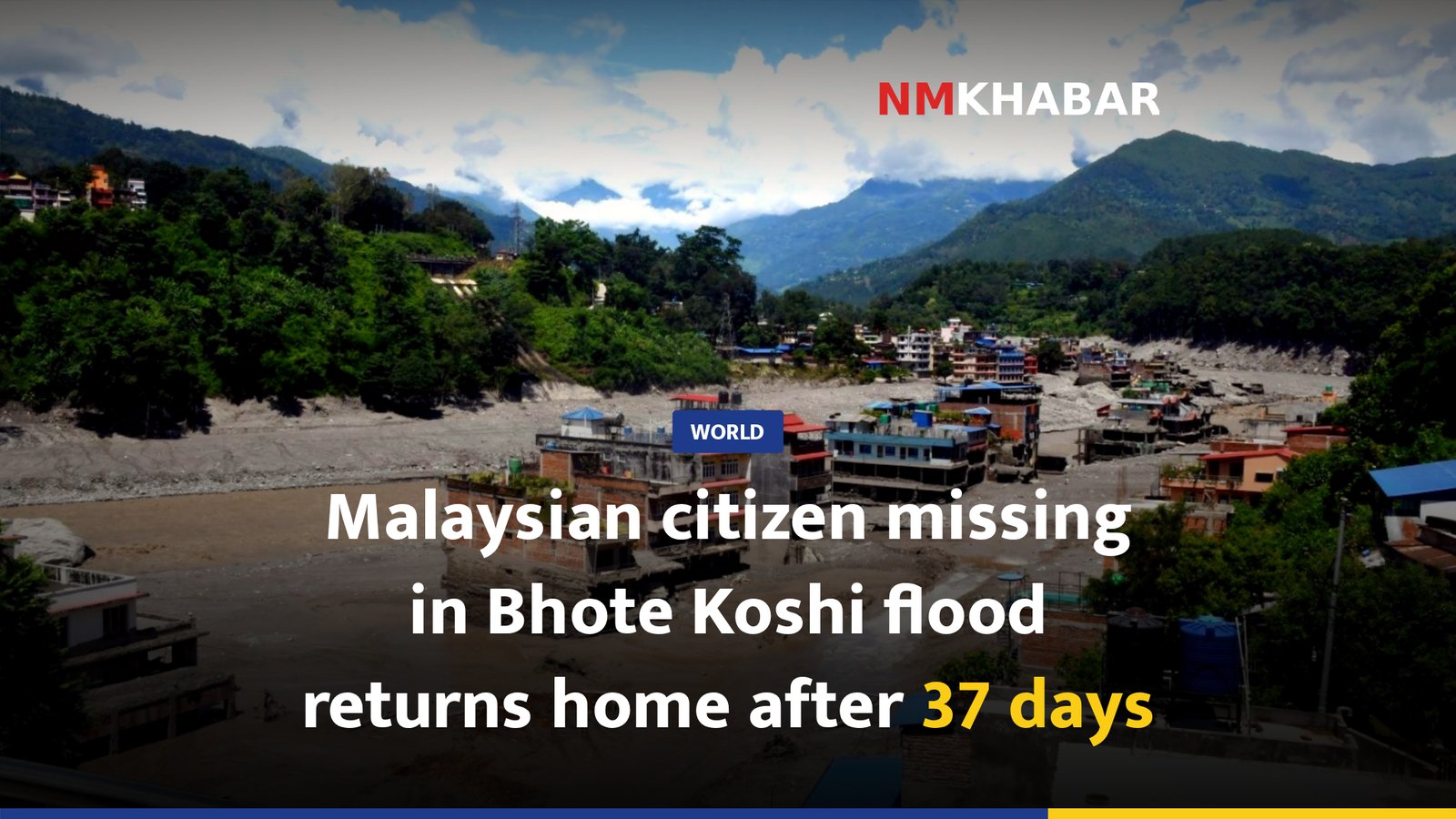
A Malaysian citizen, who went missing for 37 days after the catastrophic Bhote Koshi flood in Rasuwa district on August 26, 2026, has safely returned to Malaysia. This was confirmed on Friday, October 2, 2026, by Manivannan Rethinam, spokesperson for Malaysia Solidarity: Families in Hope (MOSFIH), a group representing families of missing Malaysian citizens.
The individual, a Malaysian citizen of Chinese origin, contacted the Malaysian Embassy in Kathmandu himself. Rethinam also confirmed the safe return with the individual’s close relatives. This incident reduces the number of Malaysian citizens still missing in Nepal from 55 to 54.
Communication breakdown
The missing Malaysian citizen was last known to be at Nagthali Viewpoint on August 25 (Bhadra 9) at 3:26 PM. The Bhote Koshi flood, which occurred the following morning, severely damaged roads and bridges in the area, leading to a loss of communication. The lack of electricity, water, and internet services further complicated his movement and ability to contact anyone.
The catastrophic flood in the Bhote Koshi river in Rasuwa, Bagmati province, on August 26, 2026, at 8:40 AM, caused extensive damage to lives and property. It is believed to have originated from Tibet, possibly linked to a glacial lake outburst or an avalanche in the Himalayan region. The flood impacted hydropower projects, bridges, roads, vehicles, and market areas.
Ongoing search and recovery efforts
According to data from the National Disaster Risk Reduction and Management Authority (NDRRMA), Nepal’s government body for disaster management, as of October 1, 2026, a total of 5,285 people remain missing due to the Rasuwa-Bhote Koshi flood and other monsoon-related disasters. So far, 1,454 bodies or human remains have been recovered from the affected areas, but only 112 have been identified.
The government has decided to modify its ongoing search and rescue operations in the flood-affected regions, shifting towards a “search and recovery” process. Dr. Dharmaraj Upreti, the executive chief of the NDRRMA, stated that search efforts are continuing in two tunnels, but the focus has now expanded beyond rescue to include rehabilitation.
For the permanent resettlement of displaced families, safe locations will be selected based on a report submitted by the Land Identification and Search Committee, formed by a ministerial decision of the Ministry of Land Management, Cooperatives, Federal Affairs and General Administration. Furthermore, the Insurance Authority has issued a procedure for claim payments related to the August 26 (Bhadra 10) Bhote Koshi flood, which mandates a 50% advance payment based on initial reports.
By September 30, 2026, the Prime Minister’s Disaster Relief Fund and the Prime Minister’s Relief Fund had accumulated over Rs 16.15 billion for flood relief and rehabilitation efforts.
Unanswered questions remain
The name of the Malaysian citizen who returned after 37 days missing in the Bhote Koshi flood has not been publicly released. Details regarding the current status of the remaining 54 Malaysian citizens still missing in Nepal are also unavailable. Furthermore, comprehensive information on the current state of electricity, water, and internet services in the Nagthali Viewpoint area is not yet available.