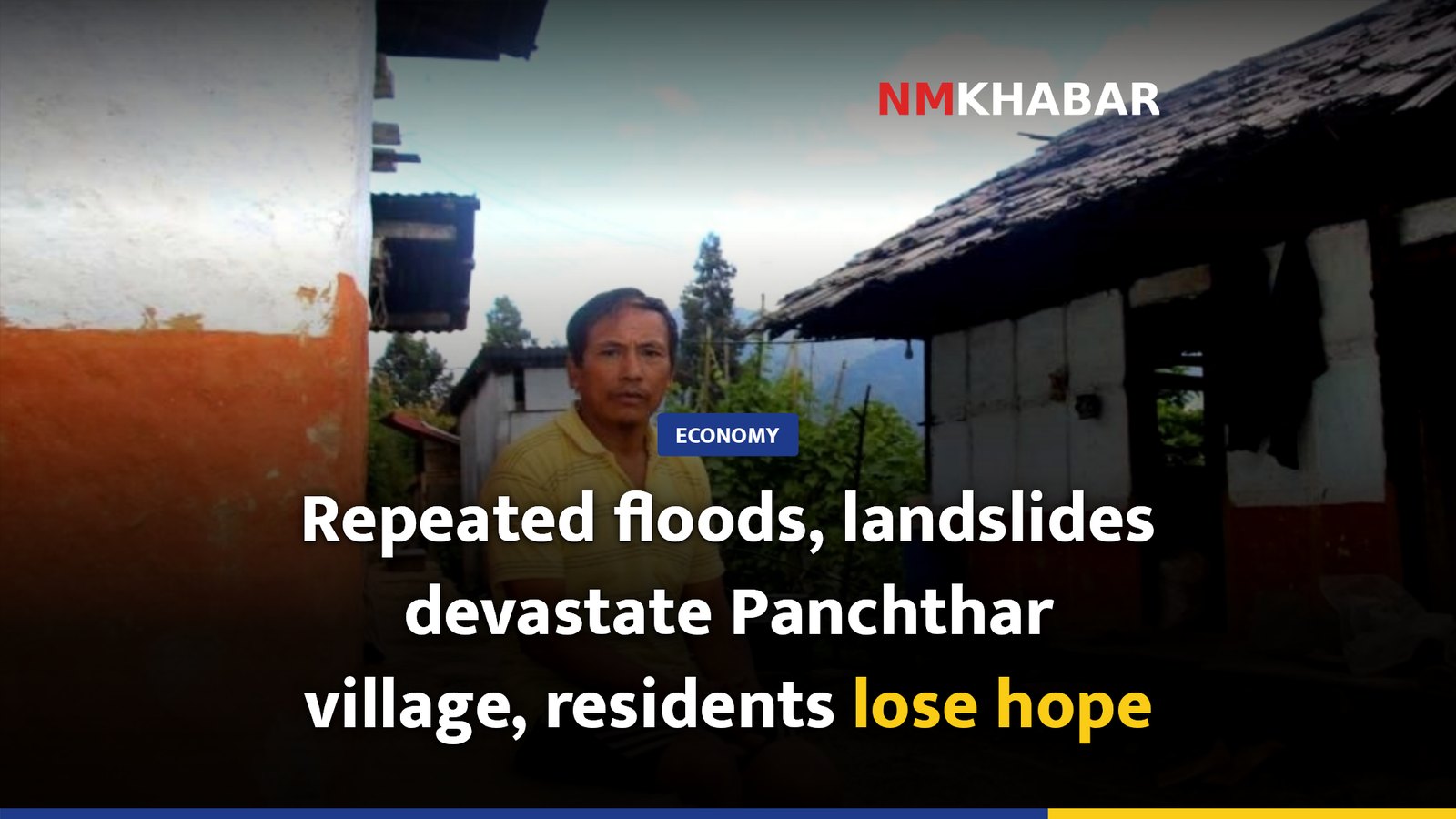
YANGWARAK, Panchthar – Residents of Yangwarak Rural Municipality-1 in Panchthar district, Koshi Province, are living in fear after devastating floods and landslides struck the area on May 22, 2026 (Jestha 8, 2083 BS), for the second time in three years, sweeping away homes and livelihoods and leaving victims disillusioned with government relief efforts.
The latest disaster, which occurred on May 22, 2026 (Jestha 8, 2083 BS), caused extensive damage, particularly to settlements along the Murunga, Mewa, and Lambakhola streams. Maha Lal Khawas of Chamlingdanda saw his house, valued at at least Rs 1 million, along with his land and all belongings, completely washed away. His brother Kabirman Khawas’s house was also destroyed.
“The flood had flowed through our yard before, but we never thought it would sweep away the entire house,” Khawas recounted. “We managed to flee with the clothes on our backs within two minutes. A minute later, the house was gone. We survived by escaping in the middle of the night.”
The Khawas family is now living in a mortgaged house belonging to Deu Kumar Rai, relying on financial support from a son working abroad. Maha Lal Khawas expressed that the fear has not left them.
Ram Kumar Rai, also from Chamlingdanda, saw his house spared but lost his primary source of income. In 2080 BS (2023), a landslide swept away his cardamom farm, which annually produced about 10 man (40 kilograms). This year, the floods and landslides destroyed an even larger farm, capable of yielding around 15 man (60 kilograms) of cardamom, along with two paddy fields. “No one in this ward has suffered as much loss as I have,” Rai said. “Now, it’s all barren land. Not a single cardamom plant remains.”
Local resident Indra Bahadur Chamling noted that after the 2080 BS (2023) disaster, many believed such a calamity would not recur in their lifetime. “But this time, an even bigger disaster struck, and we were astonished,” he said, adding that the repeated devastation has forced them to live in constant fear. Rabin Rai’s house in Chamlingdanda is also at risk, with a landslide pulling away land below his home and floods burying fields in front.
Beyond individual homes, the recent disaster damaged critical infrastructure. This included the Indrawati River bridge connecting Panchthar and Taplejung, the under-construction Limbuni motorable bridge linking Hilihang and Taplejung, and several suspension bridges in Yangwarak Rural Municipality-1 and -2. The Tharpu–Chiwa Bhanjyang section of the Mid-Hill Highway was blocked by landslides, and a diversion and an under-construction bridge at Dobhane were swept away. Mobile network and electricity services were also disrupted.
Frustration with relief process
The government has a provision to provide Rs 400,000 to families whose homes are completely destroyed by natural disasters, disbursed in three installments through the District Disaster Relief Committee. However, the complex process of obtaining this aid has led to deep frustration among victims.
Maha Lal Khawas, for instance, spent Rs 9,000, borrowed from a lender, trying to navigate the bureaucratic hurdles at the local municipality and the district headquarters, Phidim. He eventually gave up. “Now I won’t pursue it; I’ll just build it myself,” Khawas stated. “Searching for relief only puts one in debt. I’ll live in someone else’s house for a while longer.” The Khawas family plans to find land on a hillside in their village and build a new home with the help of their son who is abroad, having lost all hope in government assistance.
Ram Kumar Rai shares similar sentiments. He applied for compensation after the 2080 BS (2023) disaster but received no relief. “We were asked to apply for compensation, but since there was no compensation for the previous damage, I didn’t even feel like submitting details for this loss,” Rai said. “It’s enough that we survived.” He believes that local levels cannot provide compensation, and higher authorities are indifferent.
A history of repeated devastation
The recent floods and landslides echo a similar catastrophe that struck the same region on Ashar 3, 2080 BS (June 18, 2023). That event caused significant damage to roads, bridges, suspension bridges, physical structures, houses, and sheds in settlements such as Samarjung, Magardanda, Kopche, Kholaghari, Chok, Chamlingdanda, and Biruwa. The 2023 disaster in Koshi Province, affecting Sankhuwasabha, Panchthar, and Taplejung, resulted in three deaths and 34 people missing. Nine-year-old Juna Sawaden of Phaleung Rural Municipality, Panchthar, died after being rescued from a landslide.
In Panchthar alone, 119 families (574 people) across four local levels were affected in 2023, with 14 homes completely displaced and 86 homes at high risk. The Nepali Army rescued 12 people trapped in a landslide at Phedi, Yangwarak-1, on June 19, 2023. By Ashoj 30, 2083 BS (September 30, 2026), floods and landslides had claimed 44 lives across Koshi Province, with 37 in Ilam and the remainder in Panchthar, Morang, Sunsari, Udayapur, and Khotang.
Nepal faces a high risk of natural and non-natural disasters due to its complex topography, fragile geological conditions, seasonal climatic variations, climate change, population growth, poverty, and unplanned development. Climate change is altering the nature and frequency of weather-related hazards, posing new challenges for disaster management. The National Disaster Risk Reduction and Management Authority (NDRRMA), Nepal’s central body for disaster risk reduction and management, established on Kartik 29, 2076 BS (November 15, 2019), serves as the central body for disaster risk reduction and management. Yangwarak Rural Municipality had prepared a “Disaster Preparedness and Response Plan” in 2080 BS (2023).
Uncertain future for victims
With little hope for government aid, affected families like the Khawas and Rai are planning to rebuild their lives independently. The Panchthar District Administration Office issued warnings on Ashar 26, 2082 BS (July 10, 2025), about high flood and landslide risks during continuous rainfall, urging caution for travelers on vulnerable road sections.
However, detailed official statistics on the total physical and human losses from the May 22, 2026 (Jestha 8, 2083 BS), floods and landslides in Yangwarak Rural Municipality-1 are yet to be released. Information on concrete long-term rehabilitation plans or assistance from the government or other agencies for the affected families remains unavailable. Furthermore, the effectiveness of Yangwarak Rural Municipality’s “Disaster Preparedness and Response Plan, 2080” in addressing this year’s disaster is not yet clear.