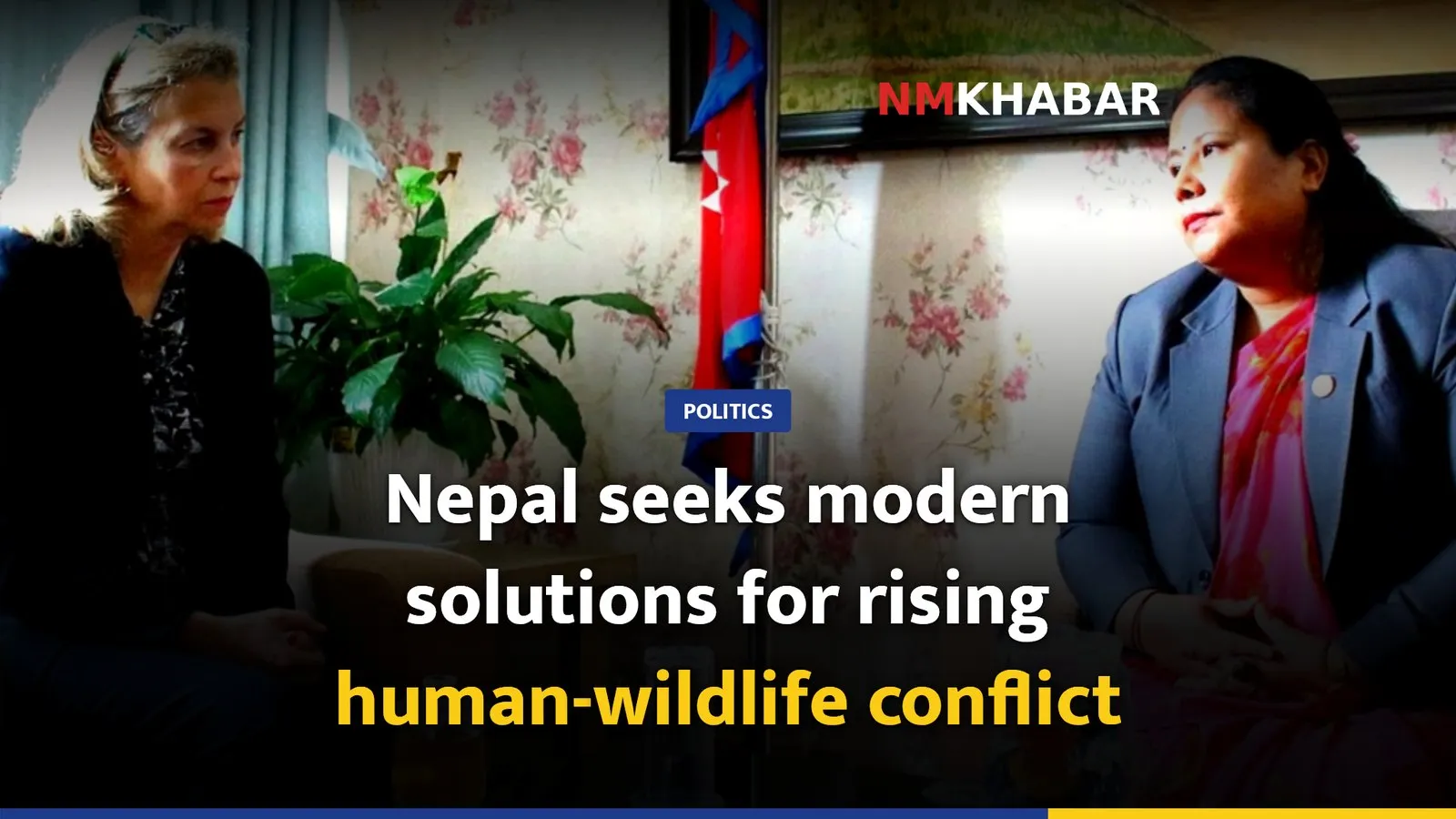
Nepal’s Agriculture, Forest and Environment Minister Geeta Chaudhary and Loren Mayer, the chief executive officer of the World Wildlife Fund (WWF) America, met to discuss the urgent need for modern technology and scientific management to address escalating human-wildlife conflict in Nepal.
The discussion focused on the growing challenges posed by increasing tiger, elephant, and monkey populations across the country. Minister Chaudhary highlighted the necessity of advanced solutions for managing human-tiger conflict, the persistent problem of wild elephants, and the widespread issue of monkeys affecting approximately 55 districts.
During the meeting, Minister Chaudhary also thanked WWF for its support during recent floods and disasters, outlining the damage to agricultural land and forest areas and the challenges of reconstruction. She emphasized prioritizing long-term climate and disaster resilience development alongside rebuilding efforts. Mayer reaffirmed WWF’s continued collaboration with the government during this difficult period, stressing the importance of sustainable, nature-based, and climate-resilient reconstruction. She pledged WWF’s assistance in mobilizing international technology, knowledge, and resources according to Nepal’s needs.
Addressing specific conflicts
Specific solutions for human-wildlife conflict were discussed, including sterilization technology for monkey management, special projects for elephant management, and the potential establishment of dedicated conservation areas for man-eating tigers. Nepal’s wild tiger population reached 429 in 2026, a significant increase from 355 in 2022 and 121 in 2009, according to the national tiger census released by the government on July 29, 2026. This growth, while a conservation success, has heightened the risk of human-tiger conflict, habitat fragmentation, and poaching.
Human-elephant conflict has also been severe, with 72 human fatalities and 26 elephant deaths recorded in Jhapa, a district in the Terai region, over the past two decades, as of October 10, 2025. Elephants are responsible for over 40% of human casualties and 70% of human fatalities caused by wildlife in Nepal. The Terai region, including Madhesh Province, is particularly affected by human-elephant conflict, with districts like Siraha, a district in Madhesh Province, experiencing continuous threats from wild elephants damaging homes. Farmers in Bahundangi, Jhapa district, have begun cultivating tea and lemons instead of rice and maize to mitigate crop damage from elephants.
Ongoing and future initiatives
Minister Geeta Chaudhary assumed her current role on March 27, 2026, following the formation of the new government led by Prime Minister Balen Shah. She leads the Ministry of Agriculture, Forest and Environment, which was established on May 14, 2026, by merging the former Ministry of Agriculture and Livestock Development and the Ministry of Forests and Environment.
Nepal has a strong track record in tiger conservation, having achieved its TX2 goal of doubling the tiger population by 2022 ahead of schedule. To manage human-tiger interactions, WWF Nepal and the Ministry of Forests and Environment signed an agreement on February 10, 2026, to implement a $4.5 million Global Environment Facility (GEF) project. For monkey management, a two-year pilot sterilization program, led by a six-member expert team, began in Diktel in April 2026, with plans for nationwide expansion. Discussions are also underway for a 50-hectare tiger park near Chitwan National Park to house ‘problematic’ tigers in a semi-natural enclosure, funding their care through tourism. Additionally, a partnership between Nepal and Thailand aims to enhance human-elephant coexistence through capacity building, joint research, technology transfer, and community awareness programs.
While these initiatives are underway, the specific timeline for establishing special conservation areas for man-eating tigers remains unknown. Detailed implementation plans and funding mechanisms for all proposed solutions, including the ‘special project’ for elephant management, are yet to be fully clarified.