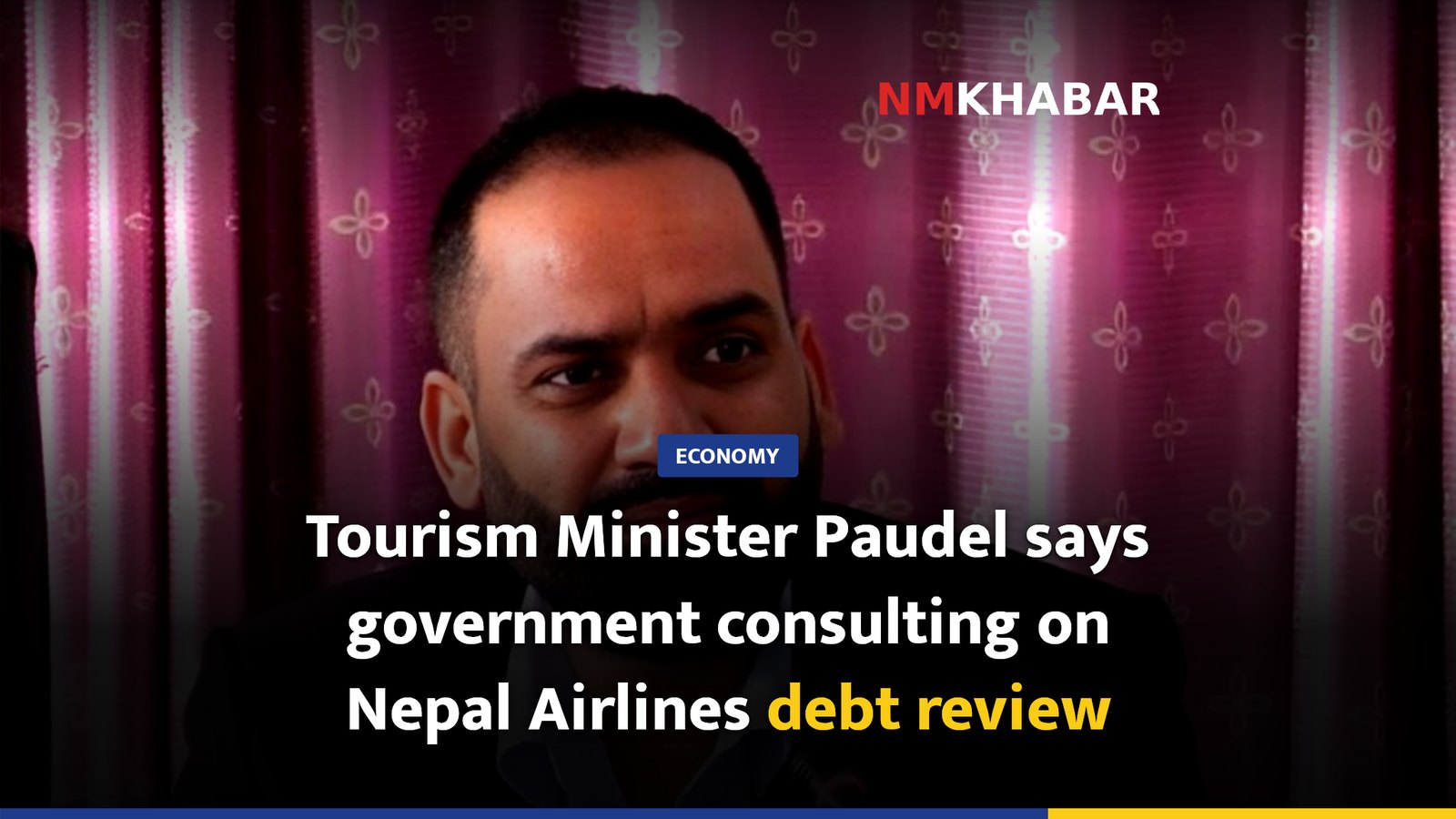
The government is holding consultations to review interest rates on loans to manage the substantial financial liabilities of Nepal Airlines Corporation (NAC), the national flag carrier, Minister for Culture, Tourism and Civil Aviation Khadak Raj Paudel announced on Monday, October 5, 2026.
Speaking at a meeting of the House of Representatives’ International Relations and Tourism Committee, Minister Paudel stated that the corporation’s current debt, estimated at Rs 50–56 billion, is not “unmanageable” for an institution with NAC’s brand and assets. He confirmed that discussions are underway with Prime Minister Balen Shah and Finance Minister Dr. Swarnim Wagle to facilitate a solution.
NAC’s primary financial burden stems from loans taken from two major public savings institutions: Rs 31.33 billion from the Employees’ Provident Fund, a major public savings institution, and Rs 21.12 billion from the Citizen Investment Trust, another public investment fund. These loans, totaling Rs 36 billion initially, were acquired in 2070 and 2074 BS for aircraft purchases, with the government acting as guarantor. The interest rates on these loans range from 9.5 to 10.5 percent, significantly higher than the current market rates of 4.5 to 5.5 percent. The COVID-19 pandemic further exacerbated the situation, adding approximately Rs 7 billion in extra interest burden on the corporation.
Addressing Financial Challenges
Minister Paudel emphasized that while NAC is not a profit-oriented institution, it must achieve financial capability and orderliness. He highlighted that the main problem lies in managing the existing loans and their high interest rates. He expressed belief that modifying these interest rates would improve NAC’s cash flow, enabling further progress through internal resources or alternative strategies.
Policy-level efforts are also focusing on making the interest rates and instalment payment processes more practical. Paudel noted that since both the Employees’ Provident Fund and the Citizen Investment Trust hold public and employee savings, the government is obligated to find a balanced solution that safeguards these investments.
Operational Hurdles and Future Plans
Beyond financial restructuring, NAC faces several operational challenges. The corporation requires approximately Rs 8 billion for the maintenance of four engines, but the tender process has encountered difficulties due to bank guarantee provisions. Furthermore, the recent resignations of five widebody captains could pose risks to widebody flight operations. NAC’s share of Nepal’s total air market, valued between Rs 120–135 billion, stands at only 15–16 percent, generating about Rs 18 billion.
Minister Paudel suggested that if immediate funds for new aircraft purchases are insufficient, NAC could operate planes on lease or increase income by optimizing existing flight schedules. He also informed the committee that inter-ministry coordination has been intensified to free the corporation from its crisis, recognizing its national responsibility as a public body.
Looking ahead, discussions are ongoing within NAC’s board regarding corporate restructuring, which requires clear government guidance. Officials from the corporation have stressed the need for active government intervention for loan restructuring, as lenders have been reluctant to agree to restructuring or interest modifications until old dues are cleared. Minister Paudel also mentioned the government’s policy to explore a public-private partnership model for NAC’s improvement, advocating for public debate on the matter. Lawmaker Ganesh Bahadur Bishwakarma of the Nepal Communist Party urged for ‘action research’ with expert involvement rather than hasty decisions for NAC’s reform.
The specific timeline for government decisions on interest rate review and loan restructuring remains unclear, as do the detailed outcomes of the discussions with the Prime Minister and Finance Minister. The full scope of the proposed corporate restructuring plan and the resolution of the widebody captain resignations are also yet to be fully disclosed.